On PC building
I became interested in PC building about a decade ago due to two events: one, the Pentium G3258 was released in 2014 and quickly became famous as a low-cost, easily overclockable dual core CPU. It really lowered the barrier to entry for novices like me. Two, I encountered a clip of two men playing a combat flight sim using an early version of the Oculus Rift and I wanted the same for myself. Such an experience could only be achieved with a dedicated gaming PC. My little ThinkPad simply would not do.
My first PC was built in a Silverstone Sugo SG05 case. I had seen the case online and liked the design enough to attempt a project despite the fact that building a PC is a small case is a bit more challenging -- much like building a model boat in a bottle. You learn to be creative in order to solve technical problems with the build. I made incremental changes to it over the years.
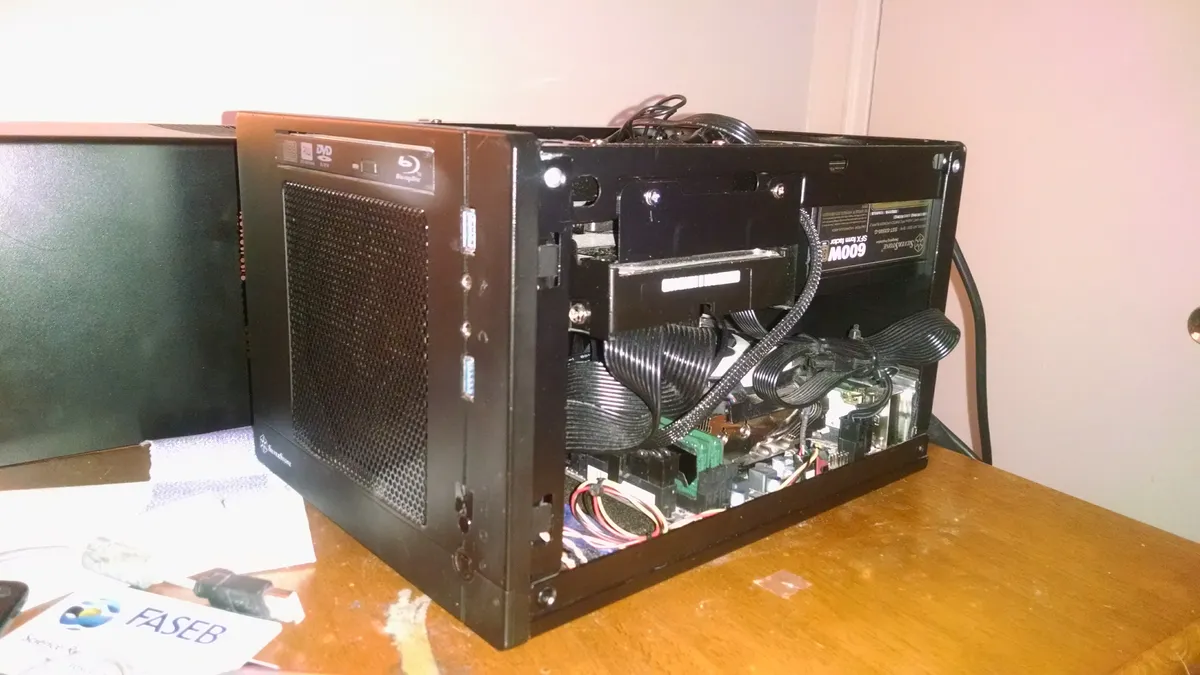
In its final form it included an overclocked, water-cooled i5-4690K, 16 GB DDR3 RAM, a GTX 1080 GPU, an SSD, an HDD, and a BluRay drive. I learned a lot building it, and am still a little proud of it.
In late 2020, during the pandemic, I decided to to upgrade my machine. Primarily I wanted a new GPU, and intended to keep the rest of the machine constant. Unfortunately none of the newest GPUs would fit in my Sugo SG05. I enjoyed the challenge of building small form factor PCs back then, and still insisted on having an optical drive. This left me with just a few options, and ultimately I chose the SilverStone Fortress FTZ01.
In the process of finding that new case I began to realize that I would need to update more parts as well. I would need a new air cooler which could fit in the narrow case, and a different brand of optical drive. As the necessary changes accumulated I scrapped the idea of migrating my old machine and began to design a new one from scratch: around the i7-9700k. The low profile cooler I selected couldn't handle any overclocking of course so I had to be content with the stock speed.
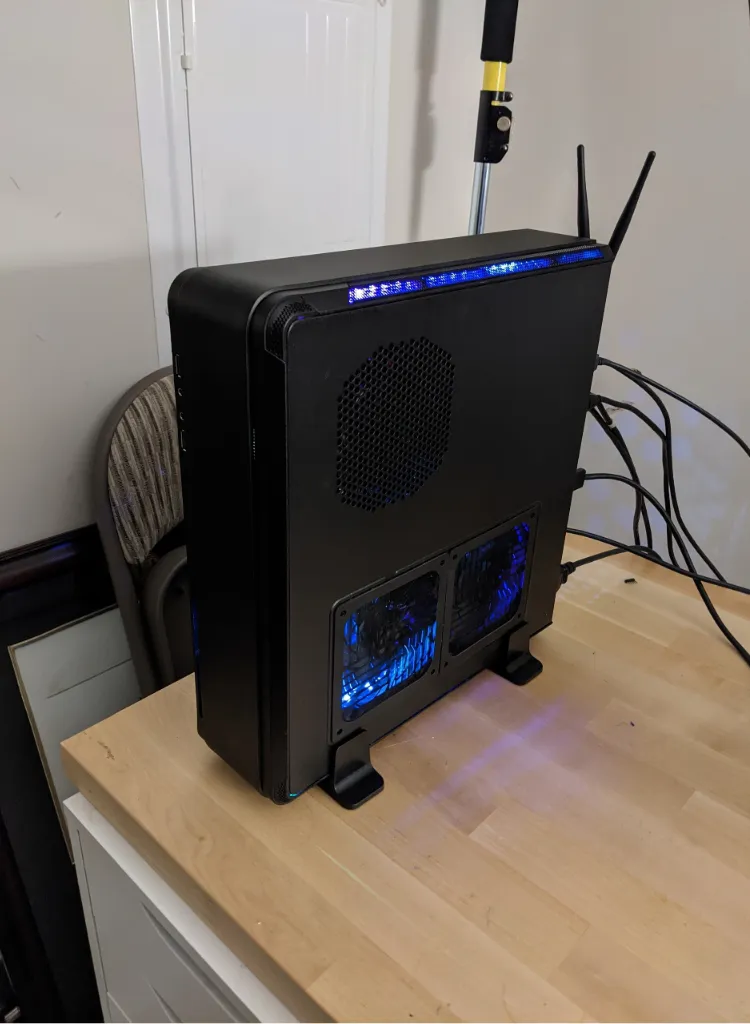
The FTZ01 had a lot of quirks which made it the most challenging case I've ever built in! The instructions were unclear and there are several screws which are hard to reach. Ultimately I had to consult some online resources in order to complete the build. But once again I was proud of the result and the machine gave me some great memories.
The FTZ01 had some other disadvantages too. It is very difficult, if not impossible to make any kind of upgrade without disassembling and reassembling the entire machine.
Now it's 2025. Once again I decided it was time for a change. I've already maxed out the RAM on my motherboard, and the upgrade path from the 9700K is very limited. The only "better" CPU that fits in my motherboard's CPU socket would be a 9900k, and the performance improvements over the 9700k in gaming would be marginal. Switching to any newer CPU would mean getting a new motherboard and probably new DDR5 RAM (unless I can find an modern motherboard that still takes DDR4 RAM.)
I should mention here that Intel has really struggled since 2020. Their 13th and 14th generation chips were plagued by chip degradation at higher voltages and clock speeds, and their 15th generation chips have not impressed consumers. Intel, once the undisputed King, is no longer recommended over its competitors anymore.
By contrast AMD CPUs (and for that matter, GPUs) have leapfrogged ahead. And AMD has built a reputation for being more consumer friendly by supporting their CPU sockets for a longer period of time - theoretically you could buy a CPU early in the socket lifecycle and upgrade a five years later to a better one. Intel just doesn't re-use its CPU sockets as long, which means upgrades require replacing more parts.
Unfortunately, in my case, we are midway through the AMD socket lifecycle projected to end in 2027. If I buy a new AMD motherboard and CPU now, my upgrade path will end in just a couple years. The best time to buy an AMD CPU (for the AM5 socket) would have been two years ago. Better to wait for AM6 (or hope that Intel has gotten its act together by then).
This means that the most cost effective way to "upgrade my machine" is to overclock it, which requires better cooling, which requires escaping the the small form factor. Giving up on SFF feels like the PC equivalent of moving to the suburbs. It makes me a boring normie. But it allows me more options.
With all that said, here is the latest version of my PC, after migration to a new case.
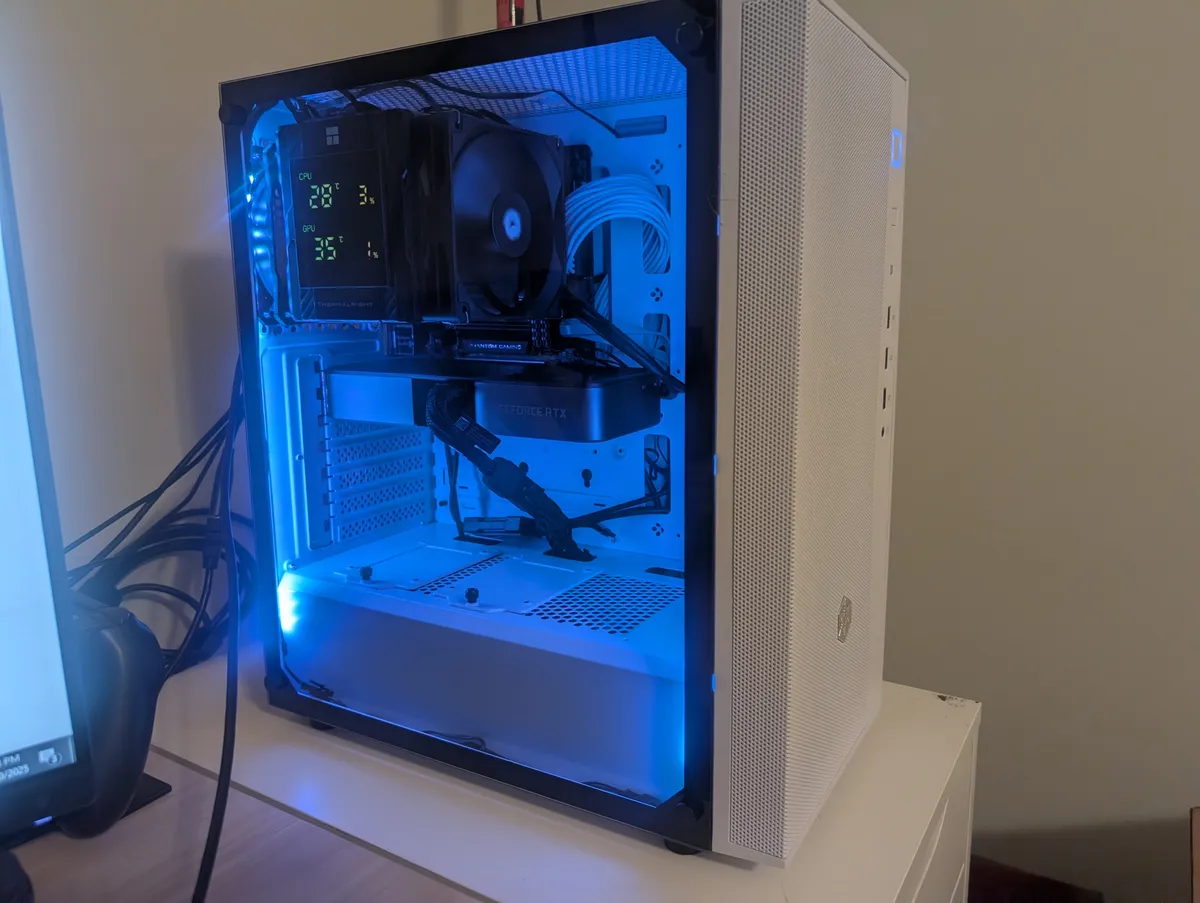
Case: Silverstone FARA R1 White
CPU: Intel i7-9700k
Cooler: Thermalright Peerless Assassin Digital
Motherboard: AsRock Z390 Phantom Gaming ITX/ac
RAM: Corsair Vengeance DDR4 (16 GB x 2)
GPU: NVIDIA RTX 3070 Founders Edition
Modifications: all case and cooler fans replaced with Noctua NF-A12x25 (since I share an office now, quiet is paramount), aRGB led strips for interior lighting.
(It's the first machine I've built without an optical drive. I'll have to find a USB adapter at some point.)
So those are the three PCs I've built. Feels like more since I've disassembled and rebuilt each one a few times, and have helped friends with their own builds.
What's next? I don't play video games as much as I used to so I don't feel the need to have the latest-and-greatest of everything -- but I do like to have access to a decent machine when I need serious computing power. With the larger case I no longer need to limit myself to ITX motherboards, and m I would love to build a PC with more slots for PCIE devices. So my next machine will likely use a micro ATX or even ATX board.
I have considered switching to the latest AMD chips, but since I keep my PCs for five years the key AMD advantage (upgradability) isn't that valuable to me. I have also considered upgrading to the i5-14600k - it's a few years old and very cheap now, but I admit I worry about the history of chip degradation. Maybe I can hang on for just another year and jump to the AM6 or LGA 1954 socket on the ground floor. We will see what 2026 holds.